
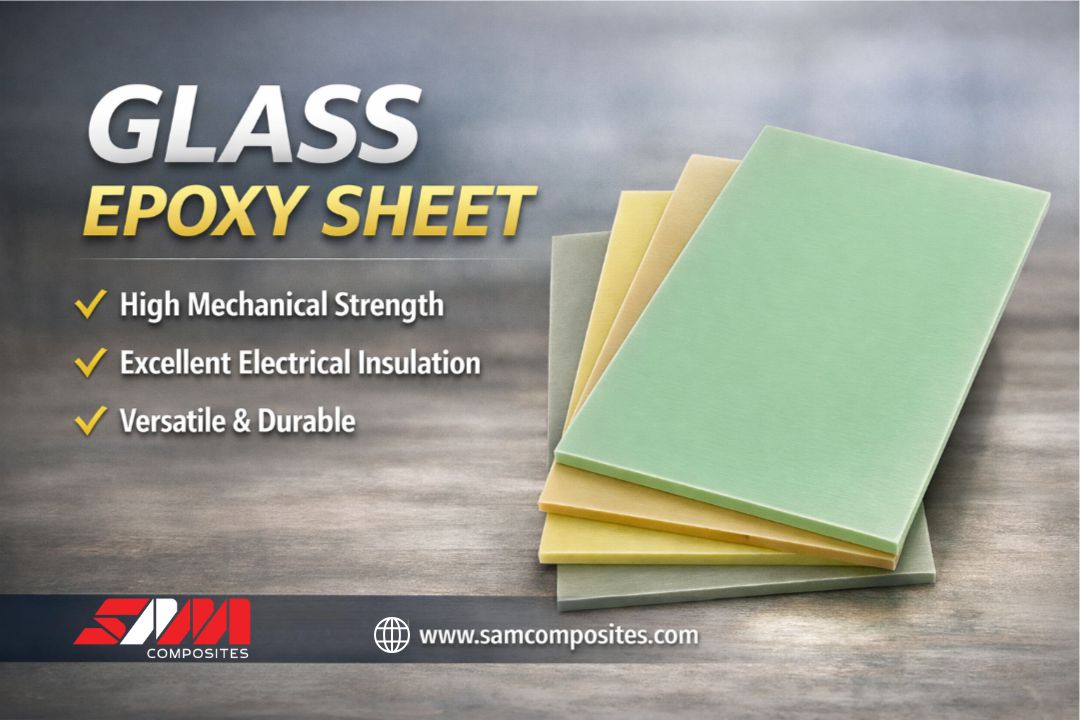
Every material in the industrial world comes with its own strengths and shortcomings. Metals offer strength but add weight. Plastics resist corrosion but lack rigidity. Ceramics tolerate heat but are fragile. No single material is perfect on its own. That is where composites come in. Composite materials are created by combining two or more materials so that one supports the weaknesses of the other. In composites, the matrix binds everything together, while the reinforcement provides strength and structure. A glass epoxy sheet is one of the finest examples of this balance. Leading glass epoxy sheet manufacturers in India, such as Sam Composites, work with carefully selected raw materials to produce composite laminates that serve electrical, mechanical, and industrial applications reliably.
Understanding the Composition of Glass Epoxy Sheets (Fabric & Resin)
Before selecting a glass epoxy sheet manufacturer in India, it is useful to understand what truly gives this material its performance the raw materials behind it. At its core, a glass epoxy sheet is made from two main elements: fiberglass fabric and epoxy resin. Each plays a unique role, and together they create a material that is far more capable than either one alone.
The Resin – The Protective Binder
Fiberglass fabric forms the inner framework of a glass epoxy sheet. It is woven from fine strands of glass, much like a textile cloth, but designed for strength rather than softness. This fabric provides the sheet with its shape, rigidity, and load-bearing ability.
The fabric contributes:
- Mechanical strength
- Structural stability
- Resistance to stretching and bending
- Tolerance to heat
On its own, however, fiberglass can be brittle. Under sharp impact or point pressure, it may crack or fracture. It has strength, but it needs support and protection.
The Resin – The Protective Binder
Epoxy resin acts as the binding and protective layer within the composite. It flows through the fabric, coating every fiber and locking the structure in place once cured.
Epoxy resin brings:
- Electrical insulation
- Protection from moisture and humidity
- Resistance to oils, chemicals, and solvents
- A smooth and stable surface
While epoxy is an excellent insulator and protective material, it is not designed to carry heavy mechanical loads by itself. Over time, repeated stress can cause it to deform if used alone.
When Fabric Meets Resin – A Composite in Balance
When fiberglass fabric and epoxy resin are combined under controlled heat and pressure, they form a unified composite where each material strengthens the other.
The fabric becomes the skeleton. The resin becomes the shield.
Together, they create a material that is:
- Lightweight yet rigid
- Electrically non-conductive
- Resistant to weathering and ageing
- Stable under repeated loads
- Reliable in harsh industrial environments
This balance is what allows glass epoxy sheets to quietly perform critical roles supporting structures, insulating electrical systems, and protecting equipment from heat, moisture, and mechanical stress.
How to Choose Glass Epoxy Sheet Manufacturers in India
Choosing the right manufacturer is not only about cost. It is about how well the manufacturer understands and controls these raw materials.
Here are the main factors to consider:
Understanding Your Application Needs
Glass epoxy sheets are used in many different environments.
In switchgear and control panels, they must prevent electrical conduction.
In transformers and motors, they must tolerate heat and vibration.
A reliable manufacturer understands how fabric type and resin formulation influence performance and can guide you toward a suitable grade for your application.
Grades of Glass Epoxy Sheets
By changing the weave of the fabric and the formulation of the resin, different grades of glass epoxy sheets are produced.
Common grades include:
- G10 – General-purpose grade for electrical and mechanical use
- FR-4 – Flame-retardant grade used widely in electronics and panels
- G11 – Designed for higher temperature endurance
- G30 – Built for improved mechanical reliability
Each grade is simply a different way of combining the same raw materials fabric and resin to suit a different working condition.
Standards and Certifications
Trusted glass epoxy sheet manufacturers align their production with recognized international standards such as IEC, NEMA, RoHS, and REACH. Compliance with these standards indicates that the manufacturer follows controlled processes, uses approved raw materials, and maintains consistent quality in the finished sheets. These certifications also ensure that the material meets safety requirements and environmental regulations, making it suitable for use in electrical, industrial, and export-oriented applications.
Conclusion
Glass epoxy sheets are more than just industrial boards. They are the result of a careful partnership between woven glass fabric and protective epoxy resin. One gives strength, the other gives protection and together they form a material that is dependable, stable, and long-lasting. They support machines without bending, insulate electrical systems without failing, and withstand heat, moisture, and chemicals with quiet reliability.
If you are looking for dependable glass epoxy sheet manufacturers in India, explore the range offered by Sam Composites, where thoughtfully selected raw materials are shaped into durable composite solutions for modern industries.